The obviously increasing cognitive dissonance — the dementia — evident in President Donald Trump and his current erratic focus on Venezuela, Greenland, Iran and blatant lies about the state of the US economy have rather distracted much media attention form Israel, Gaza and, especially the occupied West Bank of Palestine. But in Gaza now, children are dying because of the winter cold, the appalling living conditions and the fact that even baby formula as well as medicines and other essentials are still being withheld from the population. And settler violence in the occupied territories continues at an ever higher level.
Here we have evidence of the final slide of Israeli fascism to its nadir, the rock bottom: nazism. Such a system does not require gas chambers, merely the ethnic cleanings and killing, with impunity, of members an identified group of people. Bombs and drones — at a distance — do this massively and technocratically. But the same vile business is brought home more acutely by the settler thugs who rampage through the occupied territories murdering, stealing, burning and pillaging. Dressed in the cloak of religion, they foul the name and image of Judaism and all human dignity.
That they are allowed to not only continue, but to proliferate is a sign— perhaps even more so than Gaza — that Zionazism has arrived.
But at least there are people on the ground such as the menders and supporters of human rights groups such as B’Tselem and reporters such as Gideon Levy and photographer Alex Levac who provide evidence to Israel and the world of the shocking reality. In the future, no sane person who lives at this time, will be able to claim that they did not know what was happening.
Here, as 2026 gets underway, I am forwarding the latest column produced by Gideon Levy and published in Haaretz:
January 17, 2026.
After setting fire last fall to one of the largest and oldest plant nurseries in the West Bank, causing millions of shekels in damage, settlers returned to the site this month, torching cars and brutally attacking an older worker.
By Gideon Levy and photographer Alex Levac
He’s running for his life, this older man, pursued by a large group of masked men brandishing metal rods. He trips and falls on his stomach. One of the pursuers kicks him, another smashes his back twice with a rod. The man gets to his knees, as if begging for his life. The first assailant kicks him again as he sprawls on the ground.
The group circles its prey – a choreography of terror. He raises his arms to shield himself from the blows. But then, as the gang is about to leave, a second group of pogromists appears from another direction. Taking turns, they proceed to kick the man, all over his body; one especially brutal boot is aimed at his face. Before departing, after a few minutes, the thugs wallop him one more time with their clubs.
The setting for these vicious attacks, in broad daylight, was pastoral: the plant nursery owned by the Junaidi brothers in the West Bank town of Deir Sharaf, not far from Nablus. The assault last Thursday was the seventh incident involving settlers at the nursery since the war broke out over two years ago in Gaza.
The victim of the pogrom was Basim Saleh Yassin, 68, deaf from birth and a father of six. He’s worked in the Junaidis’ greenhouses for 25 years. This week he was recovering in the intensive care unit at Rafidia Hospital, Nablus, between operations on various parts of his body. One of the nursery owners visits him twice a day, communicating with him via sign language, which he has picked up over the years. From their mute exchange he understands that Basim is in great pain.
January 8 attack on Basim Saleh Yassin at the Junaidi brothers’ nursery in Deir Sharaf, near Nablus
His assailants were dozens of masked settlers who burst into the nursery at 2:45 P.M. After examining footage from the 10 security cameras installed in the nursery in the wake of other settler attacks, the owners concluded that a total of 37 men, divided into several squads, were involved – and they did not appear to be children or adolescents (Video is available on X from which Terry Bell is banned).
The groups apparently came to torch the workers’ cars, setting fire to four vehicles parked at the site before heading back to where they’d started off: at one of two new, unauthorized outposts nearby, satellites of the longtime settlement of Shavei Shomron. Security footage shows them entering the nursery on the run, eager to execute their sacred mission. A few minutes later they are seen running out and pummeling the deaf worker lying on the ground.
After examining footage from the 10 security cameras installed in the nursery in the wake of other settler attacks, the owners concluded that a total of 37 men, divided into several squads, were involved – and they did not appear to be children or adolescents.
This was not the most serious pogrom visited on the Junaidis’ nursery. But this time, because of the injuries inflicted on Basim, the brothers were especially distraught. Indeed, they had stopped using guards to secure their property after the first assault by settlers, in late 2023, because they feared for the guards’ life. Since then the nursery has not been guarded.
The Israeli military government’s Civil Administration imposed restrictions on the owners’ plan to fence off the nursery, which is located in Area C (under full Israeli civil and security control). The Palestinians would be allowed to erect a barrier, they were told, but without concrete foundations. Thus, currently, in the absence of proper security measures, the site is open and vulnerable to invasion.
Unlike all the previous attacks, the latest one took place while scores of workers were in the area and hundreds of cars passed by on adjacent Highway 60. The pogromists have apparently ratcheted up their brazenness because they know nothing bad will happen to them, even if they’re caught.
The Junaidi nursery opened in 1991, en route to Nablus. Israeli farmers have purchased its plants and students of agriculture in the West Bank participate in practical courses here. The CEO, Samir Junaidi, 63, manages the flourishing family business together with his two brothers, Maher, 60, and Shahar, 59. This past Sunday, their older brother, Khaled, died at the age of 81. He had served as chairman of the West Bank Olive Council, a respected man who worked in cooperation with the Jaffa-based Peres Center for Peace and Innovation.
The gate of the nursery was open last Thursday and none of the brothers were there. The swarms of assailants rushed toward the offices and the parking area; the window of Samir’s office had already been shattered during another invasion and is still covered with a piece of metal. Pairs of settlers set each of four vehicles ablaze after dousing them with flammable substances. Thick black smoke soon covered the whole area. Maher’s Volkswagen Tiguan; the Skoda Fabia owned by a worker named Kusay Abu Safa; farmer and engineer Samir Hussein’s Hyundai Santa Fe; and the Skoda station wagon driven by Ibrahim Fukaha – all went up in flames.
This week only the scorched and partly melted Fabia was still in the parking lot, awaiting removal. Abu Safa told us that all his personal documents, his mobile phone and other property were in the car. The lower leaves of a huge ficus tree that looms protectively above the lot are blackened.
Working in the greenhouse during the attack, Basim, of course, heard nothing. When he noticed the thugs storming in he began to ran but tripped – and fell prey to their brutality. His lower spine and arm were injured, and he suffers from various internal injuries. His jaw and most of his teeth were broken when an iron rod smashed into his mouth. Hussein, the farmer-engineer, was also evacuated for medical treatment, suffering from smoke inhalation.
For its part, the Israel Defense Forces arrived a few minutes after the marauders had fled. As far as is known, no one summoned the army, but its security cameras are everywhere here because of the site’s proximity to an important intersection, the Deir Sharaf checkpoint and Shavei Shomron.
The pogromists have apparently ratcheted up their brazenness because they know nothing bad will happen to them, even if they’re caught.
A Palestinian fire truck summoned from Nablus was prevented from dousing the flames at the nursery; after arriving, the soldiers allowed the firefighters to proceed only on foot. The IDF Spokesperson’s Unit this week told Haaretz that this was because of a traffic jam – not the soldiers.
On Thursdays, explains B’Tselem field researcher Abdulkarim Sadi, traffic is particularly heavy because many workers are returning home ahead of the weekend – and it is precisely then that soldiers cause delays on the roads, and mainly at Deir Sharaf, one of the harshest and most unpredictable checkpoints in the West Bank.
Samir, the nursery’s CEO, tells us this week that he was on his way from Nablus at the time. When he arrived after the attack – the fires had been extinguished within 20 minutes – he saw soldiers treating Basim, who was bleeding from his mouth and elsewhere, but conscious. A Palestinian ambulance then evacuated him to the hospital and, meanwhile, large army and police forces arrived.
An Israel Police spokesperson this week stated, in reply to a query about the incident: “Three suspects were arrested were released under restrictive conditions, and the investigation is still ongoing.”
Almost two years ago to the day, on January 16, 2024, settlers also attacked the Junaidis’ nursery, torching a forklift, a digger and a tractor. Two months later they stole tin panels and other equipment worth about 60,000 shekels (approximately $18,000). Samir says that some of the stolen equipment can still be seen in a yard in one of the settler outposts.
The next violent incursion took place in the evening of September 8, when the nursery was empty. The settlers set fire to the conference room, offices, storeroom and archive, which was of inestimable value: It contained decades worth of research-related documentation. Within two hours everything went up in flames. The damage amounted to some 3 million shekels (around $910,000),
Samir says, due also to the destruction of agricultural equipment and the contents of the safe where valuable seeds worth 800,000 shekels were stored. On that occasion, too, Palestinian firefighters were delayed at the checkpoint for about 20 minutes, he adds. After reaching the scene it took them some five hours to extinguish the flames.
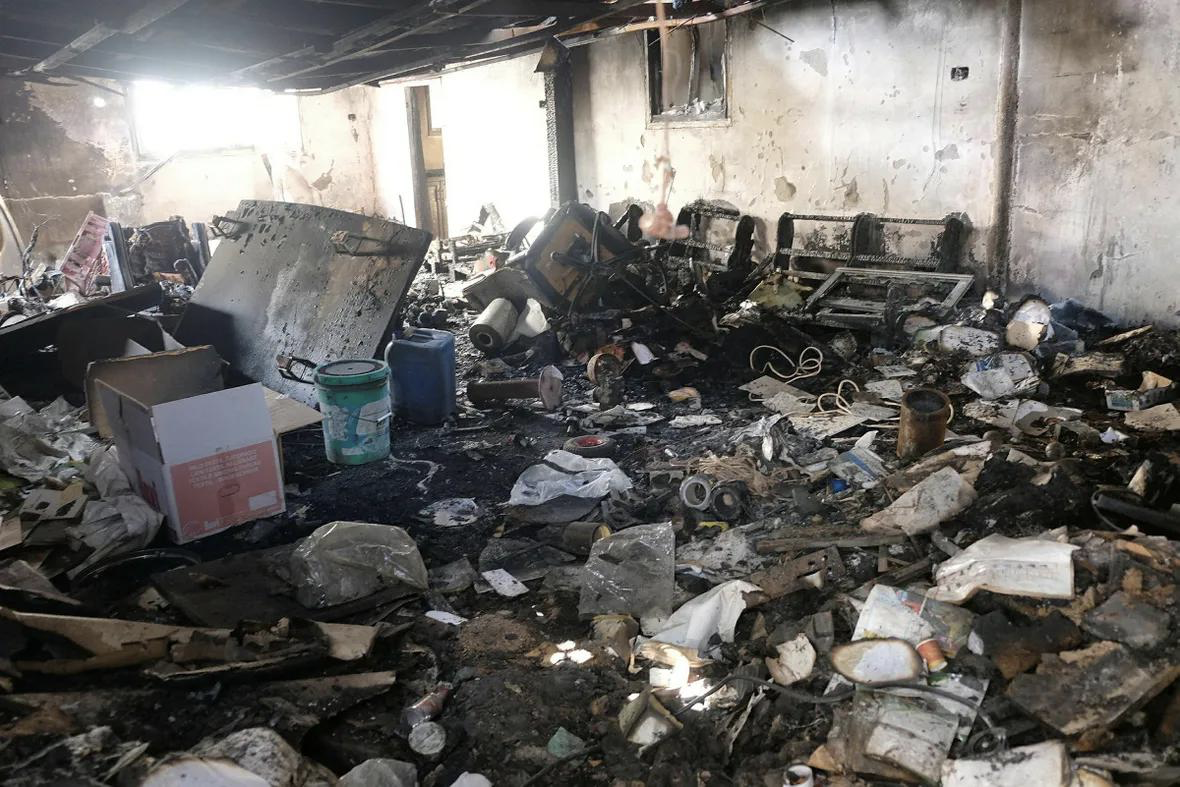
We survey the devastation outside. Nothing has been renovated here since the horrific September attack – neither the colorful two-story wooden structure housing the offices nor the other structures. All of them, including the heavy safe that lies now on a scorched floor, was reduced to a mass of black pulp. Amid the ruins, burned seed packets and documents are sticking out.
If the settlers are so fond of setting things on fire, Maher Junaidi says, he’s willing to place piles of bags and other debris outside, so they can torch them. If they enjoy slaughtering or stealing sheep, as happens frequently in the West Bank, they should move to Bulgaria or to Australia, he adds, where there are plenty of sheep.
Not a word of fury or hatred, only resignation.
 Cape Town, South Africa-based journalist commentator and author specialising in political and economic analysis and labour matters.
  Terry Bell Writes
Posted on January 17, 2026
0